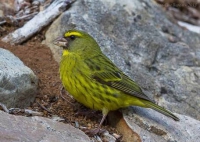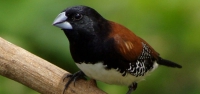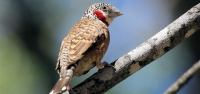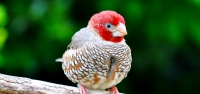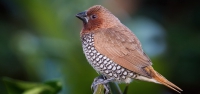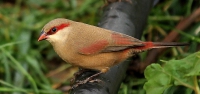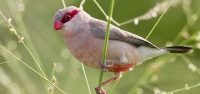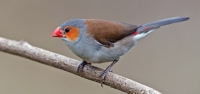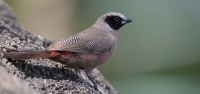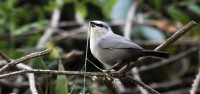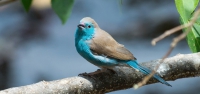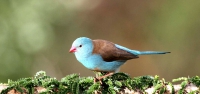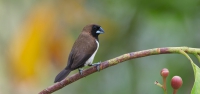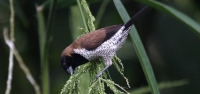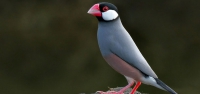
This sets the scene required to successfully raise and breed the aforementioned birds and can present quite a challenge here, due to the higher altitude and cooler climate. I have bred Violet ears at my previous home where I had some very large walk in aviaries, housing predominately softbills. I was caught by surprise one day when I was unexpectedly presented with 4 strapping young violet ears which had just left the nest.
All I can say about this breeding is that the birds bred in a clump of Bluebush ( a coarse scrublike bush that grows to a height of about 1 metre) Bluebush is cut out of the ground at just below ground level, roots and all, and these bushes are hung upside down in the aviary to provide popular nesting and roosting sites for the birds.
(As far as I can ascertain, the closest bushes obtainable in the UK to our Blue bush are Common Gorse and Common Heather, provided they are tall enough.)
At my new home I did not have the luxury of lots of space and could only find one suitable space to build an aviary. Here I built an aviary 10 m long 3m wide and 2.7m high against a stone wall that faced east . The southern end of the aviary was enclosed with polypropylene paneling on three sides and provided the main shelter against the elements.
One third of the southern end was enclosed by a combination of paneling and hailproof glass. The northern end was also enclosed with glass on top of the roof and clear plastic sheeting on three sides, while the centre third was open to the elements.This provided 3 temperature zones: a hothouse zone, a natural zone and a medium temperature zone.
At the end of 2005, in order to encourage my Violet ears to breed, I decided to experiment with their nesting site. This required a round trip of about 200 kms into the thornveld where the birds occur naturally. From here I cut a number of branches from the thorn trees which are favoured by the Violet ears as nesting sites ( Accacia tortillus---tortillus denoting the fact that the thorns on this bush occur in pairs; one pair of relatively large straight thorns, and another much smaller pair of hook thorns situated near the base of the straight thorns.) These branches were placed at strategic places in the aviary, and the birds just loved them.
The first birds to build a nest in one of the thorn branches was surprisingly enough, not South African, but a pair of South American Cuban Finches.
Soon after this, towards the end of January 2006 the one pair of Violet ears built a nest in the same site which was situated in the hot house zone.The nest was constructed from
Teff grass and was about 6 inches in diameter with a side entrance and was lined with Egyptian geese feathers. ( The time of year is significant as, by the end of January
going into February, the grasses in the natural habitat are in full seed which secures an abundant food source for breeding birds )
It was possible to see the bird in the nest, and each morning when I fed the birds, the
cock Violet ear and I would eyeball each other for a brief moment.
Incubation lasted for about 14 days and the day shift was carried out by the cock bird while presumably the night shift was carried out by the hen ( although I was never able to confirm this.) The egg clutch normally consists of 3 to 4 white eggs and on this occasion, 3 healthy looking young birds emerged from the nest. approximately 14 days later.
Once the babies hatched, the parents became very active in feeding them and took in larger quantities of termites and the odd meal worm which were fed to the birds daily.
I also provided seeding Rye Grass heads which all the birds , including the violets ears eagerly devoured.
The rest of the diet consisted of a seed mixture of red manna, Japanese millet, and canary seed. The birds were also fed wild grass seed which proved to be most popular.
In addition, Cede soft food mixed with grated carrot and mixed with mashed hardboiled egg, shell and all, were fed on a daily basis.
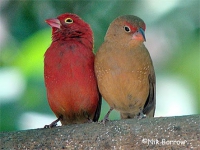
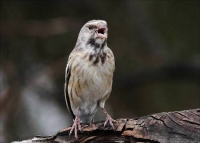
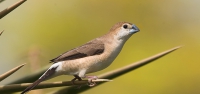
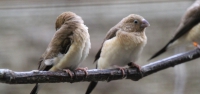
The young birds look very similar to the hen and it is only some time later when moulting, that the cock birds start darkening and colouring up.
Violet-ears are most attractive birds and can greatly enhance your collection of finches.
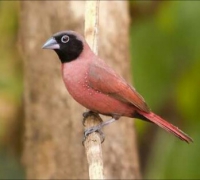
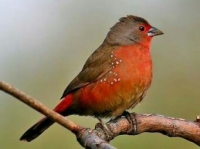
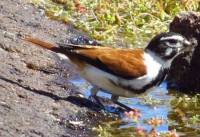
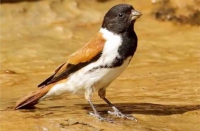
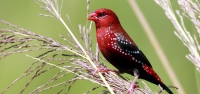
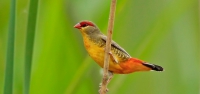
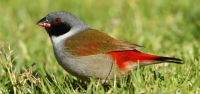
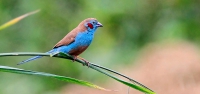
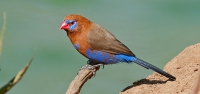
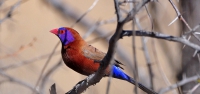
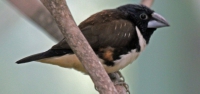
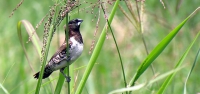
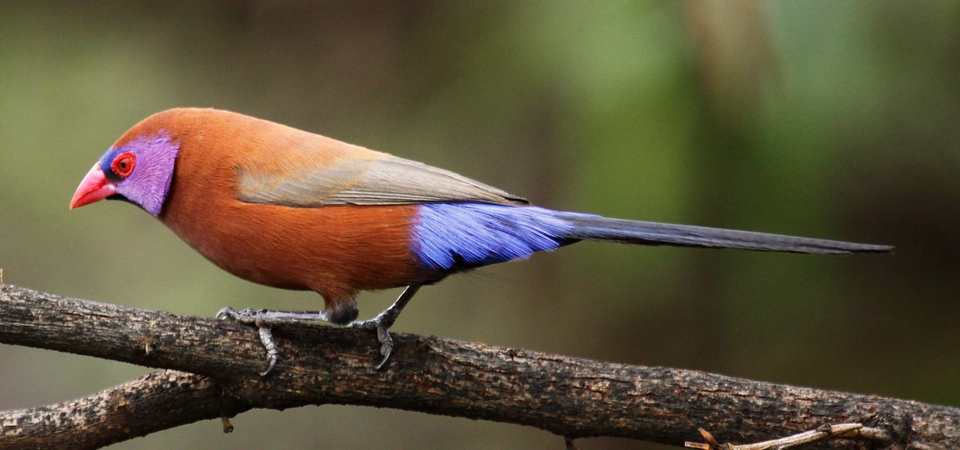
The cock bird is particularly striking with its rufus back and chest, brilliant violet ears and cheeks, cobalt blue rump and red bill. The hen is more predominantly chestnut in colour with pastel shades of violet and cobalt blue over the ears and rump.
They are good mixers, though it is better to keep one pair to an aviary to avoid interference between the species.
It should be noted that South African waxbills and finches,on the whole, with the exception of a few like the Red Billed Firefinch and Jamieson Robin nest almost exclusively in acacia thorn trees and bushes and consequently do not readily take to nesting in nest boxes They much prefer clumps of blue bushes, clumps of growing grass, or wire nests filled with teff grass. They are extremely sensitive to nest inspection and it is for these reasons that it is extremely difficult to keep accurate breeding records and to monitor their breeding habits.