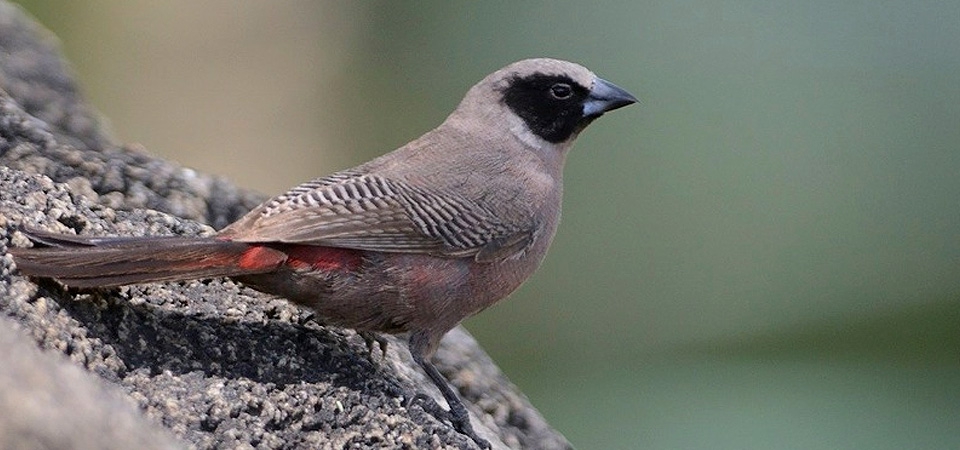
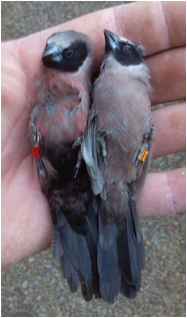
Also very easy to sex visually. A very similar species to the South-African Black-cheeked Waxbill, in fact most see it as a sub-species to our local bird, but myself and a few others disagree. But let's cover the sexing first!
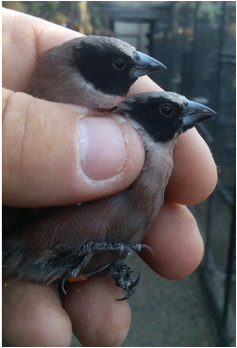
Also a slightly bigger cheek patch on the cock (cock left)
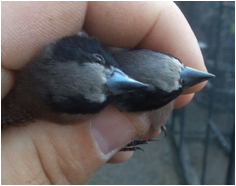
Again more evident when viewed from the top (cock left)
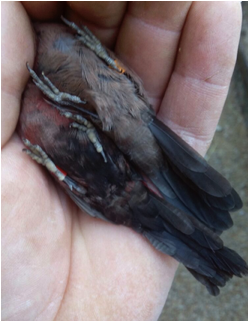
And again the cock shows much more black on the belly, ventral region and undertail coverts.
Now, back to my statement as labeling them 2 separate species I will point out the differences between them. The Southern one is the Estrilda erythronotos and the Northern one is the Estrilda charmosyna with one sub-species, the Estrilda charmosyna delameri (the bird in the pics)
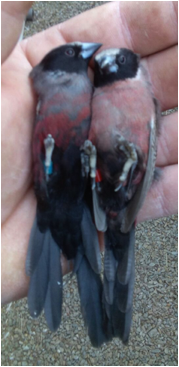
Note delameri is a much lighter bird with the darker red on the belly of erythronotos replaced with pink on delameri (delameri right)
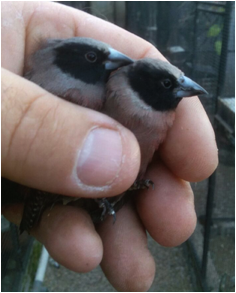
Delameri (right) also has a faint whitish border to the black mask (more evident in the more colourful charmosyna which sadly never gets imported)

The difference in the two hens are even more obvious, with delameri (left) much lighter and lacking the darker ventral region as well as the pink colouration.
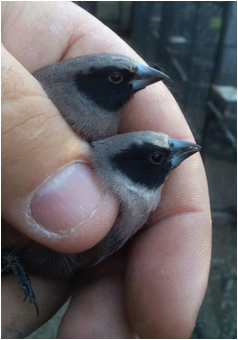
In this profile very little difference other than being lighter
Now the birds are very similar so I can understand why they are labelled as sub-species, but I base my two separate species theory on two foundations : 1 - The two are separated by around 1 600 km and in my book a sub-species is a bird that gradually changes over its continuous range, and 2 - The 2 species has a completely different call, the delameri having a very similar call to the Grey Waxbill
